
Criminal Cases in the Monroe County Courts
New York Supreme Court and Monroe County Court handle felony prosecutions in Monroe County. The title “Supreme Court” can cause real confusion here. In New York, Supreme Court is a trial court, not just an appeals court. The Monroe County Clerk serves as clerk of both Supreme and County Courts and maintains their criminal files. The Clerk makes one key limit plain: its office files only felony convictions. That counter is not a full archive of every criminal matter begun in Monroe County.
Rochester City Court hears misdemeanors and violations and arraigns felony complaints before a felony case moves on. Town and Village Justice Courts do similar local work for cases within their borders. Their files remain with those courts. A court name on the docket is therefore more useful than a broad county label. It tells a searcher which clerk can inspect the record, issue a copy, or certify the outcome.
The official Rochester City Court Criminal Branch page shows how that local branch fits the system.
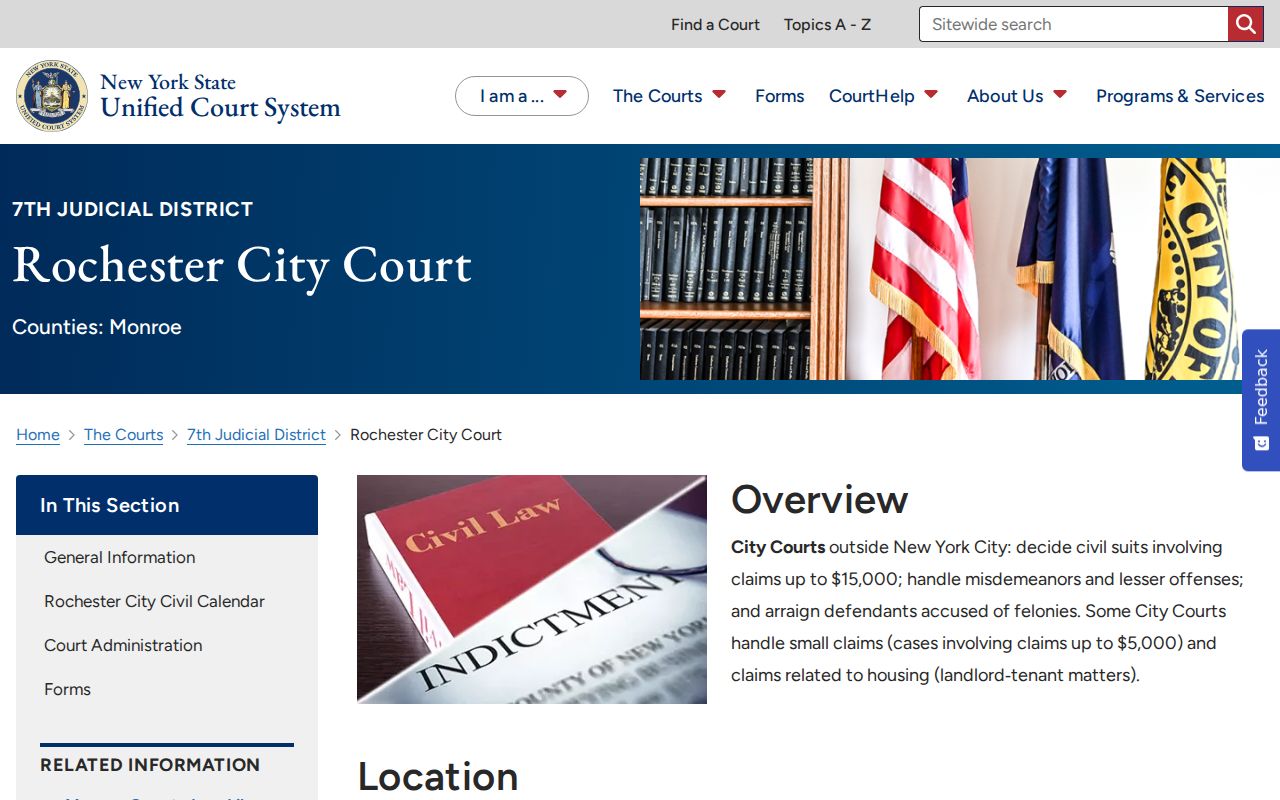
The court page points local misdemeanor and violation questions to the Rochester criminal clerk rather than the felony-file counter.
Monroe County Felony Case Files
The County Clerk public counter is in Room 105 of the Monroe County Office Building, 39 West Main Street, Rochester, NY 14614. Searchers should bring the index number and filing year when possible. They can also supply the record type, filing date, and party names. Requests may be made at the counter, by calling 585-753-1600, by fax at 585-753-1650, or by mail. Those routes matter when an online docket gives only a thin event list or no document image.
Copies cost $0.65 per page with a $1.30 minimum. Certification costs $5 for up to four pages, then $1.25 for each added page. When the index is unknown, a search costs $5 for each two-year period. The Clerk lists cash, check, Visa, and MasterCard for pickup payments. Before paying, ask whether a plain copy, certified copy, or certificate of disposition answers the question. These are not the same product.
The County Clerk records page is the source for the file scope, channels, and current fee schedule.
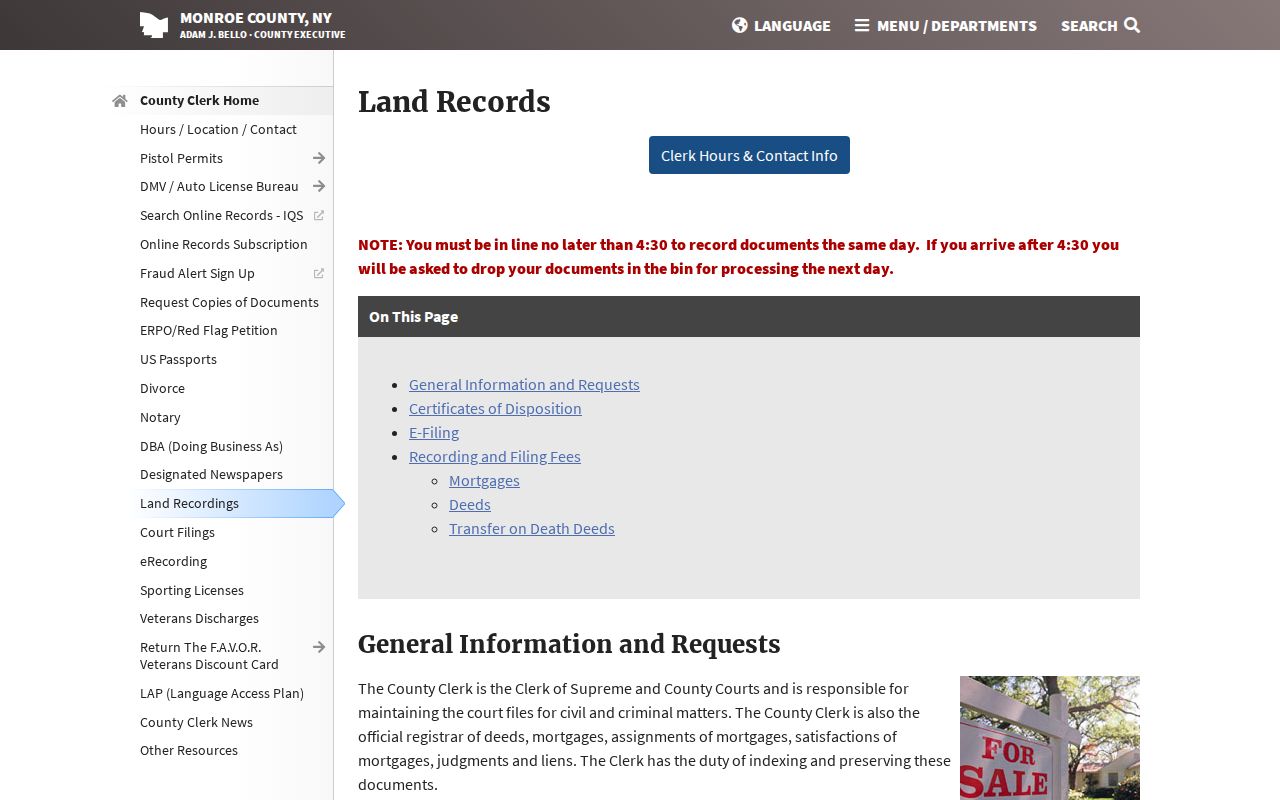
The Clerk’s published limits help prevent a wasted trip for a Rochester City Court or suburban Justice Court case.
How to Search Case Records
Use eCourts WebCrims first for an active criminal case or calendar date. It offers defendant, case, and calendar routes. It does not show warrants, completed cases, or sealed cases. For a broader public statewide search of pending cases and convictions, OCA Criminal History Record Search uses an exact full name and date of birth and charges $95 for each name and birth-date combination. CHRS Direct Access works online. Mail requests go to CHRS Unit, 25 Beaver Street, Room 940, New York, NY 10004 with a check or money order and an email address or self-addressed stamped envelope. Its result is not a certified disposition.
- Choose the WebCrims defendant, case, or calendar search based on the facts already known.
- Enter the required name fragment or the complete docket number, then select Monroe County or the right court where offered.
- Check the court, case status, and next date before treating a similar name as the sought case.
- Read the newest docket events, charges, and disposition fields instead of relying on the first charge shown.
- Contact the originating clerk for documents, older cases, or a certified final result.
These are the WebCrims controls documented by New York Courts. Calendar searches use the courtroom, not the judge’s name.
| Field Label | Type | Required | Notes |
|---|---|---|---|
| Search by Defendant / Case / Calendar | Tabs | One route | Each tab opens a different lookup method |
| Last name | Text | For name search | Enter at least the first three letters |
| First name | Text | For name search | Enter at least the first two letters |
| County / Court | Dropdown | Route dependent | Select Monroe and the relevant court where offered |
| Docket number | Text | For case search | Use the full CR-######-YYSU format |
| Court / courtroom / date | Fields | For calendar search | Use courtroom, not judge |
When Monroe County Cases Vanish
A blank WebCrims result is not proof that no Monroe County case exists. The system is built around current criminal case and calendar information. Once a case is finished, it may disappear from that public view. Warrants are also outside the search, and sealed matters are withheld. A spelling variation, short name fragment, or use of the wrong search tab can create a false dead end as well.
For a finished felony conviction, try the Monroe County Clerk with an index number or filing range. For a Rochester misdemeanor or violation, call the Rochester City Court Criminal Clerk at 585-371-3413. A Town or Village case stays with its local Justice Court, so identify the court from a notice, ticket, old docket, or CHRS result. OCA CHRS can locate public pending cases and convictions statewide, but its exact name and date-of-birth method does not prove identity by fingerprints.
Note: A missing WebCrims result may reflect system scope, sealing, case status, or search input rather than the absence of a court file.
What the Case File Shows
A Monroe County criminal case file follows the litigation, not just the arrest. The header ties the matter to a court and docket or indictment number. Filed accusatory papers state the allegations. Later entries may show counsel appearances, conferences, motions, hearings, plea or trial activity, judgment, and sentence. Original charges can differ from amended charges and the final disposition, so read the record in date order.
| Case Number & Court | Identifies the docket or indictment and the court that controls the file |
|---|---|
| Charging Document | Shows the complaint, information, or indictment and the offenses alleged |
| Docket Entries | Records filings, counsel appearances, motions, conferences, hearings, and other events |
| Hearing Dates | Lists completed appearances and, for active cases, the next scheduled court date |
| Disposition & Judgment | States whether charges ended in conviction, dismissal, acquittal, or another result |
| Sentence & Conditions | May record incarceration, probation, fine, restitution, surcharge, or release terms |
Public display varies. Social Security numbers, protected victim or minor data, and sealed information are not open fields. A date of birth may also be limited. Online access does not guarantee that each filed document can be downloaded, while the clerk may still permit inspection of a public paper file.
Read Monroe County Docket Numbers
WebCrims case searches require a complete docket in the form CR-######-YYSU. Each part helps the system route the request, so a loose number from an old note may fail. If the full value is unknown, switch to the defendant tab and use the minimum name fragments, then confirm the court and case details. Do not add a judge’s name to a calendar search. New York Courts directs users to select the court and courtroom, such as a listed courtroom code.
Several terms explain why two entries for the same case can look different:
- Complaint
- The initial accusation; a felony complaint supports arraignment but not a felony trial.
- Indictment
- A grand jury’s felony charging document, often tied to a later Supreme or County Court file.
- Disposition
- The result or current status of a charge or the case.
- Certificate of disposition
- The originating court’s certified statement of the case outcome.
Stages of a Criminal Case
A Monroe County court file grows as the case moves. Prosecutors first file an accusatory instrument. At arraignment, the court addresses charges, rights, counsel, and release conditions. Pretrial entries may cover conferences, evidence issues, motions, and hearings. A case then may end by plea, dismissal, acquittal, or verdict. If there is a conviction, judgment and sentencing complete the trial-level path.
Case flow: Charges Filed › Arraignment › Pretrial › Plea or Trial › Disposition › Sentencing
The charge listed at the start is not always the charge at the end. Prosecutors may amend or replace allegations, and a court may dismiss a count. For that reason, the latest charge-level disposition and judgment carry more weight than an early calendar entry. When the file does not make the result plain, ask the originating court for its certified outcome.
Monroe County CAP Court Route
Monroe County launched its Centralized Arraignment Part Court in March 2025 with the Seventh Judicial District, District Attorney, Public Defender, Sheriff, and municipal police departments. CAP Court gives countywide off-hours arraignments a common setting with prosecution and defense present. It is a first-stage court process, not a new all-purpose archive of every criminal case.
After arraignment, follow the matter to the court with jurisdiction. A misdemeanor may remain in the local City, Town, or Village Court. A felony complaint can begin locally, but an indictment and felony prosecution proceed in Supreme or County Court. This shift can make one Monroe County case appear to “move” between court references. It also explains why the first clerk contacted may not hold the later file.
Note: CAP Court centralizes certain off-hours arraignments, while the court that later gains jurisdiction remains the source for the continuing docket.
Access & Restrictions
Court access and agency-record access use different legal paths. Judiciary Law §255 directs court clerks to search and certify court records subject to lawful limits and fees. New York FOIL applies to agency records, but the judiciary is outside that route. A request for an existing police or county-agency record goes to its FOIL officer. A request for a court docket, filed paper, or certificate goes to the clerk that holds the case.
Favorable terminations generally trigger sealing under CPL 160.50. Other New York laws cover Clean Slate sealing, certain older convictions, youthful-offender confidentiality, and juvenile records. Sealed documents are unavailable through an ordinary public request unless the requester has statutory authority or a court order. Clerks also redact Social Security numbers and protected victim, minor, and safety information.
A person reviewing their own fingerprint-linked statewide history uses DCJS Personal Record Review, not a public court search or FOIL. That rap sheet may combine arrest cycles and reported outcomes. It remains different from the pleadings and motions in a Monroe County court file.
Proving a Monroe County Case Outcome
A certificate of disposition is the originating court’s certified statement of a case result. It answers a narrower question than WebCrims, CHRS, or a DCJS rap sheet. WebCrims helps track current court events. CHRS compiles public pending cases and convictions from a demographic search. A DCJS personal record links cycles by fingerprints. None of those products replaces the court’s own certified disposition when the final result itself must be documented.
Start with the court named on the case. Request the certificate from Rochester City Court for its cases, from the relevant Town or Village Justice Court for local matters, or through the Monroe County Clerk for a Supreme or County Court felony file. Give the docket or indictment number if known, plus the filing year and party name. Ask the clerk about its current charge and delivery method before sending payment.
If the certified result differs from a personal DCJS record, use the correction instructions that DCJS sends with the response. If WebCrims appears wrong, contact the court that entered the data. This two-record check keeps the public case display, the certified court outcome, and the fingerprint record in their proper roles.